Psychogeography was created by the Marxist theorist Guy Debord, inspired by the idea of Charles Baudelaire’s concept of the Flâneur, an urban wanderer[1]. Walking and wondering in Nature has been an integral part of my practice. Lately, my walking has become more intentional. As a Flâneuse[2], I embarked on a dérive around Geneva, using instinctive sensory methods to record images, sounds and sensory writing. The river Arve is one of my favourite places to drift and walk, and I often combine breathing and self-hypnosis.
It was a workday, cold and rainy, so barely anyone was along the riverbank. As I walked around listening to the noises of the river, I felt a strong tightness in my chest. I remembered when I had just moved to Geneva, I would go out there alone in the winter with my newborn son. He would sleep, and I would have some rest, a little time for myself. I took note of these thoughts crossing my mind. I listened and recorded the powerful noise of the river swirling around, the birds singing. I touched everything, the moss on the trees, the gritty, moist sand. I produced a piece of writing, to record the sensory stimuli, the emotions and thoughts I was experiencing, intertwined and in no particular order.
My writing made me reflect about how experience is produced. Yu-Fu Tuan defines experience as ‘the various modes through which a person knows and constructs a reality. These modes range from the more direct and passive senses of smell, taste, and touch, to active visual perception and the indirect mode of symbolization.’[3] Experience is shaped by perception, emotion and thought. In contrast with the Cartesian mind-body split[4], embodied experience refers to the concept that bodily presence and physical interactions with the world are fundamental to how we understand and engage with our environment. The body is an integral part of generating knowledge. This idea emphasizes that cognition is not just a matter of abstract thinking or mental processes but is deeply rooted in bodily experiences[5][6]. Embodiment is therefore a ‘nomadic’ state, dynamic and interconnected with its surroundings[7].
Cognitive scientist Anil Seth describes perception, as a construction of the brain making an inference, a prediction of the received stimuli. Perception is shaped by the brain network (an architectural space itself) to interpret the sensory data that comes in[8]. Theosophists Besant and Leadbeater explore the idea that thoughts create forms in the astral plane, suggesting that thoughts have a material-like existence in a subtler dimension[9]. Neuroplasticity, for example, shows how repeated thoughts and experiences can physically alter the brain’s structure[10]. In this respect, I believe that bodily experiences and sensations shape thoughts, which interpret bodily experiences and perceptions in a spiral loop that generate embodied knowledge. This idea aligns with Barad’s concept of quantum entanglement to explain how particles are interconnected in such a way that the state of one instantaneously affects the state of another, independently of their distance[11]. Humans, non-humans, emotions, thoughts and concepts have agency and reality as matter is the result of their intra-action.
Attempting to reconstruct my psychogeographic experience in Geneva, my project considered the Revivification of the memory through my hypnosis practice. Revivification utilises a person’s memory to intensely relive an experience. This is done by re-enacting perceptions calling on the senses. I used the recorded sounds as a sensory stimulus to embark on a mind journey. I saw myself wondering around along the river, touching, feeling. Other images appeared in this walk: flames, hair, braids. Images about motherhood I often see in my practice. ‘Feeling and thinking’ became ‘intertwined’ in the act of producing the image of self, manifesting how the body is the result of both its ‘structure (its sensory organs) and feeling (its perceptions)’[12]. The body as fluid and multiple, in constant change[13], while the interaction with its surroundings was shaping my evolving image of feminine self[14], as a new mother and a migrant. Identity emerged ‘as an interconnection between space, time, embodiment’ and ‘everyday lived experiences’[15].
Artists Lee Ufan and Wolfgang Laib deploy psychogeographic walking, as process for questioning and spirituality. Lee Ufan’s sculptures engage viewers to reflect on the nature of perception and the physical presence of objects. Wolfgang Laib regularly spends entire summers in the Black Forest wandering and filling jars with pollen which he includes in his meditative installations. Similarly, Imprints of Present, Traces of Arve is an installation that resulted from a psychogeographic walk and a mind journey. It is a visual map of the materials I gathered, the sounds I recorded, my perceptions and thoughts. Everything is interconnected yet the images are distinct. They are vestigial images of embodied experiences, volatile views of the unconscious perhaps. These images have a relationship with the body, like a flow of energies, a field that gravitates around them (Figure 1.). The entanglement of emotion and affect[16] in this work combines narratives about gender and migration with psychological aspects of embodied feelings.
Artists Verity Birt and Emily Hesse constitute significant precedents for my practice. In her film Crossings, Verity Birt traverses embodied experience as ‘the simultaneous feelings of estrangement, connection and intimacy that hide in the uncanny threshold of encounter with a world beyond the human’[17]. Hesse’s work uses a variety of materials, often incorporating elements directly from the landscapes she is investigating. Her main medium is clay, made with soil, plants, and other natural materials, which ground her work in the physicality of place. Both artists explore the relationship with the rural landscape and its emotional content as embodied experience, in the framework of female identity.
My hypnotic practice, which I consider an extension of psychogeography, is an expression of embodied and situated knowledge that leads to experience. It evokes an imaginary place by an active imagination technique that draws from all senses: sight, sound, touch, smell, taste and feel. It occurs to me how in hypnotic practice, there is also a sense of movement. The idea of walking to reach a safe place and exploring this space, while moving towards my subconscious. In this sense, the neural network is a physical space, and it produces tangible images and perceptions. Subjectivity is formed through movement and relationality[18].
New Materialism offers a perspective that acknowledges the materiality of identities and their complex entanglements with social, cultural, and environmental forces[19]. My practice engages with how interaction between thoughts, environment and perceptions relate to image making. Just before leaving Geneva to move to London for the Graduate Diploma at the RCA, I went back to the riverbank. I took my polaroid camera with me to record my walk. The choice of polaroid as medium is nostalgic, materialising my unconscious thoughts of leaving home. My melancholy manifested in my actions and interventions, soaking in solvents and scraping the images. I think of these images as phenomena, their existence entangled with thoughts, emotions, actions and perceptions of the maker and the observer (Figure 2.).
Currently, I am focussing on integrating collected materials into my installations, thus embracing a process-based approach that emphasizes the tangible and sensory aspects of art-making. This work sits within a broader discourse, that explores themes of identity, gender, and migration.
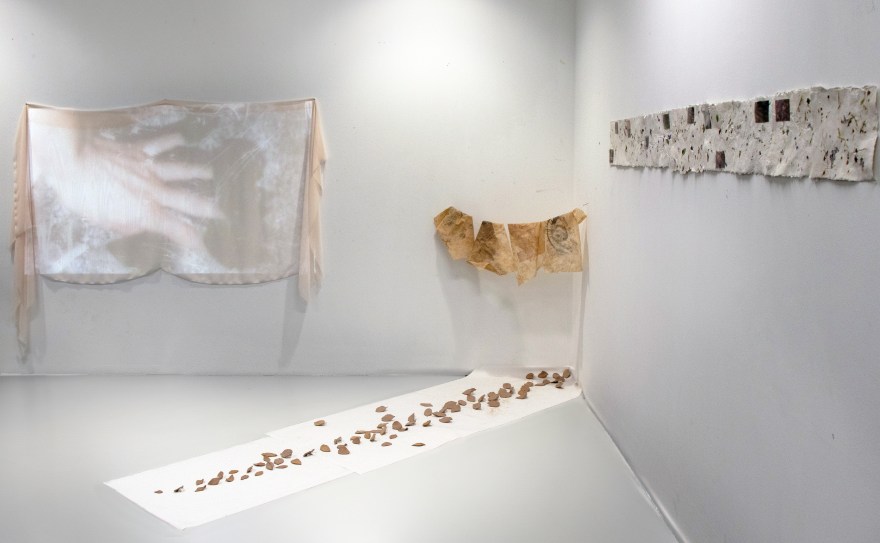
Figure 1. Imprints of Present, Traces of Arve. 2024. Mixed media installation. Handmade clay on fabric lithographs. 35×95 cm. Handmade clay leaves on canvas. 76×287 cm. Film transparencies hand stitched with hair on handmade paper with collected leaves, flowers, plants and hair. 21×260 cm. Projected film transparency on fabric. 107×150 cm.


Figure 2. Instant film transparencies obtained by soaking polaroid films in hot water, lime and scraping the film. 2024
Bibliography
Barad, Karen, Meeting the Universe Halfway: Quantum Physics and the Entanglement of Matter and Meaning (Duke University Press, 2007)
Besant, Annie, and C W. Leadbeater, Thought Forms: A Record of Clairvoyant Investigation, ed. by Lucy Lord Campana, New edition / (Sacred Bones Books, 2020)
Braidotti, Rosi, Nomadic Subjects: Embodiment and Sexual Difference in Contemporary Feminist Theory, Gender and Culture (Columbia University Press, 1994)
Crane, Tim, and Sarah Patterson, eds., History of the Mind-Body Problem, 0 edn (Routledge, 2012), doi:10.4324/9780203471029
‘Crossings-Info.Pdf’ <https://files.cargocollective.com/185135/Crossings-info.pdf> [accessed 8 June 2024]
Debord, Guy, ‘Theory of the Dérive’, Internationale Situationniste, Vol. 2, 1958
Elkin, Lauren, Flâneuse: Women Walk the City in Paris, New York, Tokyo, Venice and London, First American edition. (Farrar, 2017)
Ellingson, Laura L., Embodiment in Qualitative Research (Routledge, 2017)
Haraway, Donna, ‘Situated Knowledges: The Science Question in Feminism and the Privilege of Partial Perspective’, Feminist Studies, 14.3 (1988), pp. 575–99, doi:10.2307/3178066
James, Aleya, ‘Investigating Space and Subjectivities of Emirati Female Graduating Students in a Neoliberal City’, Doctoral Thesis, Doctor of Education (EdD), 2021
mlipodcast, ‘Anil Seth – How Our Minds Predict Our Reality’, Mind & Life Podcast, 2020 <https://podcast.mindandlife.org/anil-seth/> [accessed 7 June 2024]
Probyn, Elspeth, ‘Glass Selves: Emotions, Subjectivity, and the Research Process’, The Oxford Handbook of the Self, 2011, doi:10.1093/oxfordhb/9780199548019.003.0030
Tuan, Yi-Fu, Space and Place: The Perspective of Experience, 7. print (Univ. of Minnesota Press, 2011)
Voss, Patrice, Maryse E. Thomas, J. Miguel Cisneros-Franco, and Étienne de Villers-Sidani, ‘Dynamic Brains and the Changing Rules of Neuroplasticity: Implications for Learning and Recovery’, Frontiers in Psychology, 8 (2017), doi:10.3389/fpsyg.2017.01657
Wetherell, Margaret, Affect and Emotion: A New Social Science Understanding (2012), doi:10.4135/9781446250945
Young, Iris, ‘Lived Body vs Gender: Reflections on Social Structure and Subjectivity’, Ratio, 15 (2002), pp. 410–28, doi:10.1111/1467-9329.00200
 Eliana Marinari